

Why garage concrete fails without a coating
Bare concrete is porous. Melting snow carries dissolved de-icing salt into the slab, and repeated freeze–thaw cycles push that moisture back out, spalling the surface and leaving the pitted, chalky look common in older Connecticut garages. Oil, brake fluid and battery acid soak in and stain permanently.
A resinous coating seals the surface so contaminants sit on top instead of soaking in. Spills wipe up, salt rinses off, and the slab stops generating concrete dust that ends up on everything stored in the garage.
Coating systems we install in garages
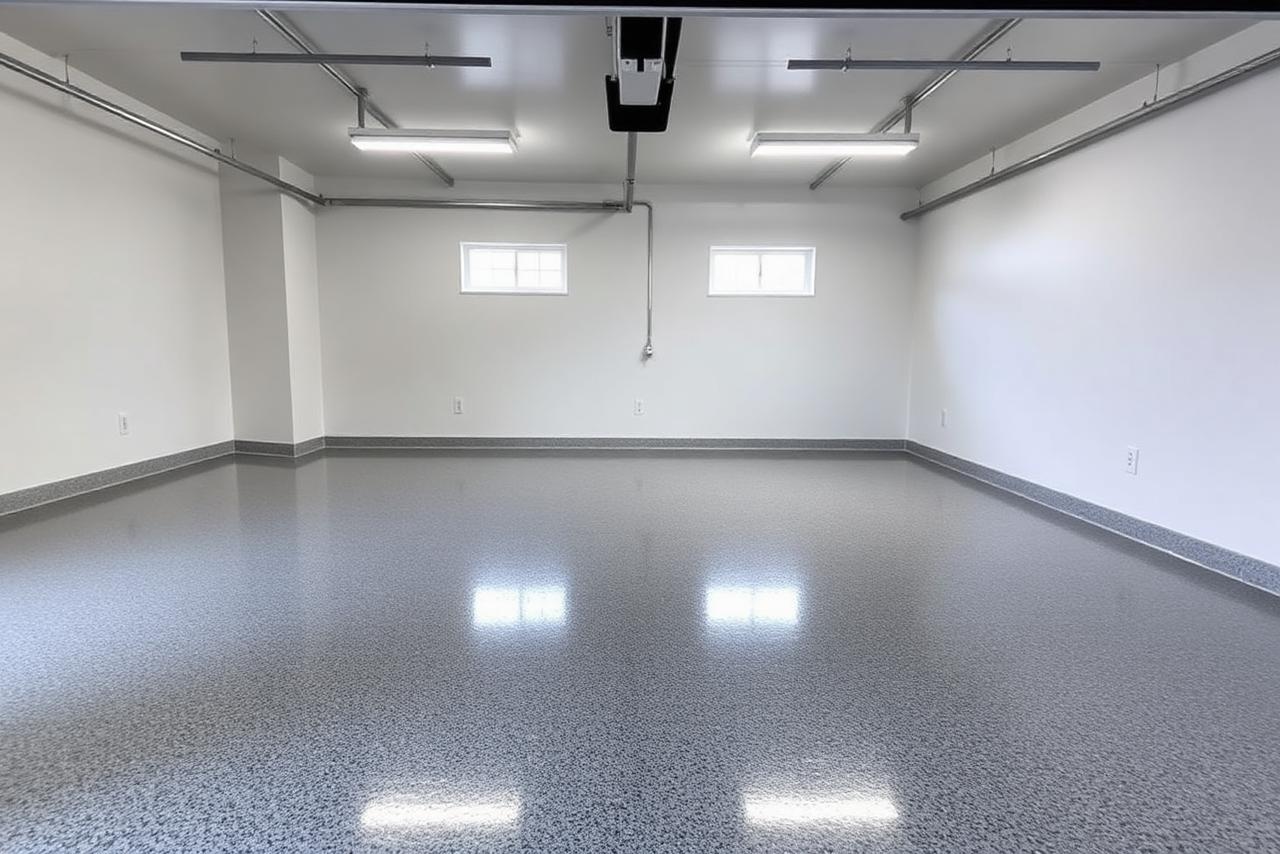
Most Connecticut garages get a full flake broadcast system: a pigmented base coat, decorative vinyl flakes broadcast to refusal, then a clear topcoat. It hides slab imperfections, adds slip resistance, and is the best value for a working garage.
Where a homeowner wants a faster return to service or maximum UV and abrasion resistance, we specify a polyaspartic topcoat instead of a standard clear epoxy. Solid color and metallic systems are also available where the look matters more than texture.
- Full flake broadcast — the standard for garages
- Polyaspartic topcoat option for faster return to service
- Solid color for a clean, uniform shop look
- Metallic for showroom and enthusiast garages
Concrete preparation comes first
Adhesion is everything. We mechanically profile the slab with diamond grinders rather than acid etching, which gives the coating a clean, open surface to bond into. Oil-contaminated areas are degreased and re-ground, control joints and cracks are cut out and filled, and spalled areas are patched with a repair mortar before any coating goes down.
Where a slab shows signs of moisture drive, we address it before installation rather than coating over it. Read more about how we handle the slab on our concrete preparation and repair page.
Installation day, start to finish
Most single- and two-car garages are a one- to two-day install. We ask that the garage be emptied before we arrive. Grinding is done with vacuum-shrouded equipment to keep dust contained, then the floor is vacuumed, joints treated, base coat applied, flake broadcast, and the excess flake scraped and vacuumed before the topcoat.
We hand you written, project-specific return-to-service times at completion. Foot traffic typically comes first, vehicle traffic several days later depending on the system and site temperature.
Keeping a coated garage floor looking new
Dust mop regularly, rinse road salt off in winter, and clean with a pH-neutral cleaner and a soft mop. Avoid citrus, vinegar and solvent-based cleaners, and put a mat under vehicle jacks and welding work. That is genuinely the whole maintenance routine.